Wednesday, December 17, 2008

Hand-on Cheddar


According to the ground-breaking work of Howard Gardner, professor of cognition and education at Harvard, there are seven types of intelligence, not just one: linguistic, logical-mathematical, musical, bodily-kinesthetic, spatial, interpersonal, and intrapersonal. His theory, put forth in the early 1980s, challenged traditional notions of human intelligence as a single entity, given to us at birth, and recognized that each person has a unique blend of intelligences. This paradigm shift (though not accepted in all academic circles) encourages a more complete picture of a person's cognitive strengths and weaknesses.

I wonder what Gardner would make of me. I have a unique blend of deficiencies.

This personal mix of shortcomings complicates my work at the cheese shop, especially when I have to do a task with my hands, which is pretty much all day long. Cutting a wedge of cheese from its pointy nose with a wire, wrapping it neatly in butcher paper with a crisp French pleat, and covering the exposed sides of working pieces of Cheddar are no-brainer jobs which should be easy, but are tremendously difficult for me. My hands refuse to cooperate even though the mind is willing. This shouldn't be. According to Loe, a fellow American in the shop who trained as a bio-engineer, electronics companies intentionally select women for small, detailed work. They have better fine motor skills than men. My clumsy work puts a wrinkle in this stereotype. Those companies surely wouldn't want me and my dopey hands. I feel thankful that Neal's Yard Dairy does.

My chief goal for the past two months at Neal's Yard Dairy was to get to know Cheddar better. What better way to familiarize yourself with an object than to put your hands directing on it. I find myself, however, avoiding the tasks of wrapping quarter-wheels and hefty working pieces of Cheddar in cling film because of the certain frustration--on my part and my fellow mongers'-- and the imperfect job that would ensue. There can be no flaws; the cling film should look like glass when finished and be hard to detect. That's not the case when I try. I spend far too long trying to get the cling film and tape to cooperate, and the end result looks like crap. For the sake of the shop, I concede the Cheddars to someone else.

My daft hands make me a weak link in the shop. When a socially awkward guy, but surprisingly big spender, came in on the first morning that we were open on a Sunday for the Christmas season, before my coffee had kicked in, and ordered 12 gift boxes of six different cheeses, I had to rope in the support of my fellow mongers because I knew that I wouldn't wrap the cheeses well enough to merit his paying 908 pounds sterling in one shot. I won't go far in the cheese world with this lack of manual dexterity and high level of caffeine dependency.

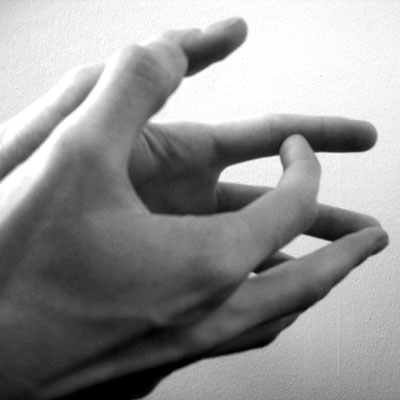
I don't mind grunt work with my hands, like cleaning cheese crates and knives. The severely chapped condition of the skin on my wrists and fingers prove that I am doing my job, or at least part of it. (I'd take a picture of my hands to show the hard work they've been subjected to, but my computer is so old that I can't upload photos to flickr and now my camera has now been stolen, so I don't even have the pictures any more. I should have kept my hands on my camera!) The satisfyingly tactile nature of the job--patting and rubbing and squishing rounds, wheels, and slices of cheese--has kept me from wearing protective blue plastic gloves. I'd lose the hands-on pleasure of my job if I did.

Taking a cue from the educators who have embraced Gardner's work, I shouldn't give up hope just yet. Since we aren't necessarily born intelligent, we do have the chance to hone the areas in which we shine and develop those which cast a dull light. With practice, I should be able to wrap cheese expertly, either in butcher paper or cling film. In the words of the U.S.'s new leader and my upbeat manager who admirably focuses on the positive, Yes, we can!

Progress has already been made. Yesterday I had a full-on hands-on training in wrapping cheeses. Instead of working at the retail shop near Borough Market as I was scheduled to do, I was sent--or perhaps banished--to "packing," the wholesale and mail order division of Neal's Yard Dairy at its Arches location in Bermondsey. The ostensible reason for shifting me there there was that the shop was overstaffed due to a slow Christmas thus far. I fear, of course, that I was sent there because I've been deemed the weak link on the Borough team, as I surely was this past Saturday when there were, at times, more mongers in the shop than customers. For hours on end yesterday I wrapped cheeses.

Despite being stressed with the number of orders he and his team had to complete that day, the packing manager Flynn patiently gave me some tips on how to wrap cheeses in wax paper. I really appreciated him. He was personable and sweet in a time of high stress, and put his hand on my shoulder whenever he wanted me to do something or to express appreciation for something that I had already done. But I spent the last two hours of my shift washing cheese crates. Was I banished again from wrapping cheese? I'd like to think I wasn't. After all, my coworkers that day were temporary employees, two quiet and young ginger-haired North Americans, a seventeen-year-old drop-out musician from Lewisham, and a privileged twentysomething with a terribly posh accent who had played golf at a small college in the North Carolina and dropped out. I could fold wax paper just as well as they could!

I've been highlighting my deficiencies, but in an attempt to be positive, like my mangers, I will say that I have gotten much better at visual recognition of cheeses. Eight years ago I would have been hard-pressed to pick out a slab of one type of Cheddar (e.g., Montgomery's) that had been misplaced on a tower of another Cheddar (e.g., Keen's). Now I can. I can even distinguish them in blind tastings. And I've finally learned which cheeses go where at the end of the day when we clean the cheese slate. When I last worked at the dairy, I had to ask my manager every night which cheeses went into the cold room and which stayed out on the shop floor or went into the "cellar." Now that I know more about the different classes of cheese I can figure out what goes where, unless Martin, my manger, throws me a whammy and sends, for example, the Gorwydd Caerphilly to the cold room instead of the cellar to control its quick break down.

My time at Neal's Yard Diary is quickly come to an end. Eight more days in a row there and then it's all over. But the other manager Michael thinks I'll be back, and Martin has already invited me back for next Christmas. With a bit more time (and a few days off first), I am sure my hands, which are kinesthetic learners, would gain the intelligence they need to become expert mongers. Until then, I'll try to get my hands--and mouth--onto as many bits of Cheddar that I can.

Tuesday, December 9, 2008

Cheddar & the Black Dog


I won't beat around the bush. When I arrived in London in October 2000 to work at Neal's Yard Dairy for their busy Christmas season, I was coming out of a dark depression. By the time I had left New York--and my boyfriend and my job as a high school Latin teacher--the black dog was mercifully back in its dog house after attacking me ferociously for at least half a year. But I could still hear it barking. It's never far away.

Most of that previous year, I had grown so despondent that I wished I could make myself small enough to disappear, like a dust bunny under the sofa. In more dramatically hopeless moments, I begged my boyfriend at the time to kill me off. We were like Sid Vicious and Nancy Spungen, but without the bleached hair, heroin, grungy room at the Chelsea Hotel (though we did have a rather grotty apartment in Hells' Kitchen), punk rock, fame, cool clothes, Malcolm McLaren, and youth. Other than those things, we were exactly the same.

Travelling for a year to London, India, and Rome was just the ticket to make a decisive break from a life that had gotten me down and become almost unbearable. It forced me into new situations. But, as one is slow to learn, you don't leave yourself behind when you go off somewhere new. To quote the cult move The Adventures of Buckaroo Banzai, Wherever you go, there you are. If the black dog was by your side in New York, it will find its way to you in London, even in a stinky cheese shop.

And it did. Most of the time, I was so unsure of myself at the Dairy that one day, close to Christmas, I ended up crying in the bathroom of the Dairy--the cleanest in London, mind you--because I had almost charged someone for a quarter of Stilton instead of half of one, or vice versa. My manager caught me in time and stared at me incredulously. I felt utterly useless and couldn't contain my wretched despondency.

On this current trip, I think I've managed to outwit the black dog and leave it on the other side of the pond. Most days, I am cheerful in the cheese shop, rubbing and flipping Cheddars, giving customer the cheeses they want, making my managers and coworkers laugh, and eating delicious and variable farmstead cheese all day long. Outside the dairy, I am reliably upbeat, so much so that Inkeri told me that her friend John likes hanging out with me because I am always cheerful. It's a dramatic and welcome change to be thought of in this way.

But I know that this might not last. The black dog is a wily one. At this particular moment, it might be quarantined in a kennel in the U.S., but it will eventually find a way to loose itself and track me down in London or somewhere else in my travels, where it will sic itself upon me. Once the black dog has come into your life, it's hard to shake its scent.

For now, however, you can find me smiling in the cheese shop among two tonnes of Cheddar wheels, keeping my fingers crossed that this won't be the day that I see the black dog slinking around in the long afternoon shadows of winter.

Saturday, December 6, 2008

In London for Cheddar


I feel neutral about London.

According to a young Spanish woman at a wildly entertaining party near Manor House last Saturday that Jonathan Czar invited me to and I didn't leave until after 5 a.m., this isn't possible. Either you love London or you hate it. She loves London and has adopted it as her home.

That morning, on my walk to work, I was just thinking about how I didn't feel particularly connected to London, despite how much visual joy my walk to Covent Garden from Vauxhall brings me. Even though I have spent quite a bit of time in the city over the years, there isn't a part of London that I claim as my own and want to share with visiting friends. If they asked me what they should see, I'd tell them to go to Neal's Yard Dairy in Covent Garden, of course, and its other shop near Borough Market, as well as to the market itself and nearby Southwark Cathedral, but what else, I don't know. For the cities that I get excited about (e.g., New York, Providence, Rome, Berlin, Sydney & Melbourne), I have a mental list of must-see places. I don't for London.

If pressed, I'd suggest exploring the edgy East End and Brick Lane, which I got to know eight years ago and very much wanted to share with Deidre when she came to visit me then for New Year's (but have since forgotten), walking along the stunning south side of the Thames between Lambeth and Tower Bridges, finding a cheap but excellent play, visiting shops on Portobello Road and then having old-school cocktails at either Trailer Happiness or Montgomery's Place (or both), appreciating the clever inscriptions for Sir Hans Sloane in his eponymous square and for Sir Thomas More outside Chelsea Old Church, following the remains of the Roman wall, climbing the Monument to the Great Fire and appreciating all that was lost and subsequently rebuilt, glimpsing the opulence of Knightsbridge and the Royal Borough of Kensington and Chelsea, touring the British Museum for the Rosetta Stone, the Elgin Marbles, and the Lewis Chessmen, and strolling in as many of the beautifully manicured parks as possible.

These are all wonderful and important places, but none of them grab hold of me. I am not sure why they, or the city, don't. The reasons I can come up with are that I am put off by how needlessly expensive London is and how everything shuts early. There's also no medieval section of the city, thanks to the Great Fire, that I could easily connect with. And the churches, which I relish touring on my travels in other countries, are too cool and cerebral. Since I don't know much about English history, the existing monuments don't mean a lot to me.

If I don't love London, you may wonder why I quit my job in New York, my city, to live here for two months. It was for Cheddar, of course! Eight years ago, after working at Neal's Yard Dairy for three or four months, I vowed to work another Christmas there. It took me a while, but I finally came back.

So far, it's all been worth it, and I am actually sad that I have less than three weeks left in London. A two-month stay isn't enough time. I may not have fully connected with the city, but I've had a rich social life here, become a known regular at several pubs, started to establish myself at Neal’s Yard Dairy, and have settled into a fulfilling routine. And there's so much more I want to do and see!

The wheels of Cheddar will still be here after I've left, and I can always return to them. London is worth it just for them.

Wednesday, December 3, 2008

Wet Wheels of Cheddar


If you travel to Europe in the autumn, you expect to get wet. It's the rainy season, even in typically warm and dry places like central Italy and Spain. The rain came down so hard in Avila on a Saturday evening in October that it kept Spaniards at home until it let up. Not much can keep them from going out and enjoying the night. Needless to say, almost half of my days in Basel and Warsaw were wet ones, but I was lucky that Berlin stayed dry, especially on the day of the marathon.

London has been particularly wet this past month, with more overcast days than sunny ones. We've even had two snow showers. I know that this isn't groundbreaking news for a country known for its abysmally rainy weather, but it does seem more than usual. Even on days that start off with the sun shining, like this morning when I went for a run in Battersea Park before work, by the afternoon, the brilliant glow of the sun all too willingly yields to the gloom of grey clouds and drizzle.

What doesn't expect to get wet in London are five 25-kg. wheels of Montgomery's Cheddar, which would retail for about 500 pounds sterling each at Neal's Yard Dairy. It was my fault they got wet. While closing the cheese shop with the assistant manager Martin, I did a little dance to the deafening but motivating music of Justice, a French electronic duo. It's hard not too. The eclectic songs are really upbeat; that's why Martin blares their album Cross at each close. But even when you are bopping to the sounds of Justice, you have to keep your wits about you during a close, especially when you are wielding a hose to clean the floors. I didn't and I end up dangling the hose over several Cheddars which were on floorboards at the far end of the shop. Hard farmstead cheeses favor humid conditions--85 to 90 percent, in fact--but not a water bath. Momentarily, entranced by the music, I was oblivious to the potential damage I was causing, but Martin luckily noticed and calmly but sternly told me to stop what I was doing and I did. Fortunately I didn't completely drench them. We put the heavy wheels up on the slate counter, rubbed their wet muslin covering with blue paper towels, and left them there to dry overnight.

I feel awful about it, and stupid. As David Miller, my long-ago colleague and friend at Choate remarked, when you fuck up at a "no-brain" job, you feel like you've really fucked up. He came to this realization while working as a carpenter soon after graduating from college. I know all too well what he means. Even if, or especially because, you have an undergraduate degree from Harvard, as Dave did, you can't help but feel bad about yourself when you fail to hit a nail properly. If you can't hit a nail on the head, or show a hose who's boss, you doubt that you are capable of doing anything at all. I feel this way often. New at the job. I feared that I would be known as the slow-witted, Justice-dancing cheesemonger who gets Cheddars wet instead of the floor during a close.

Two weeks on, my psyche and the Cheddars seem to have recovered, along with my reputation. Key to their recovery was the quick attention Martin paid me and the Cheddars. He quietly let me know that I was okay, and did what he could to make sure the valuable cheese was too. On top of that, I now have enough positive work experience under my belt to know that I am not a total disaster in the workplace, even if I can't be trusted with a hose. Like wheels of Cheddar, with time I've developed a harder exterior and a more nuanced interior.

But the following night, to add injury to insult, the hose uncoiled from its holder on the wall and bumped me so hard on the nose that I thought it drew blood. Damn that hose! And a few days later I left my umbrella at my local pub and am now exposed to the rain. Damn this cold, rainy weather! But not too much. The cheese likes it even if I don't.

Monday, December 1, 2008

A Cheddar in Time

Time works magic on artisanal Cheddars. With its passage, young, milky cheeses mature and become multi-dimensional; complex, lingering flavors that weren't there at inception come into being. In time, large wheels of Cheddar become something much more than what they were when they left their molds twelve months earlier.

Like children, Cheddars depend on grown-ups for their successful maturation and aren't responsible for much on their own. For a year, 25-kg wheels of Cheddar, wrapped up in larded muslin, rest on wooden shelves in a cool and humid aging room. There, their caretakers flip them weekly to distribute evenly the moisture they contain, rub them briskly to get rid of damaging cheese mites, and iron them to see how their flavors and texture are coming along. Every two months, Randolph Hodgson inspects them to see which ones he'll take for his shop, Neal's Yard Dairy, where cheesemongers like me sell them for over 20 pounds sterling a kilo.

Cheese, as with wine, get better with time.

I don't. In fact time and I don't get along at all. I wrestle with it, trying to pin it down, but it slips away and leaves me the loser in my ongoing battle with time.

One of the main reasons I gave up everything in New York City to go travelling for 10 months was to develop a better relationship with time. For over three years, I've mentioned writing a book about Cheddar cheese, but three years on, I don't have anything to show for it. It wasn't as though I didn't have sufficient free time to write it. My job at NYU, when I wasn't meeting a publication deadline, was very much like one in France, a 40-hour work week, with an hour off for lunch. That schedule should have left me plenty of spare time to work on my book, but those chunks of free time whittled away to nothing and, as a result, I got nothing done. I hoped that by leaving my life behind, I would shake up my routine, and time would slow down and let me grab onto it.

This hasn't happened. On my free days from the dairy and in the evenings when I get home, I have a long list of things to do, but very little of it gets done. I start off with high hopes to update my blog regularly, send out proposals for articles about Cheddar, do research about cheese, plan the upcoming segments of my trip, and work on my book proposal. I even had plans, when I first arrived in London, to shadow bartenders at fancy cocktail bars to learn their craft. Usually, I am too tired, too unfocused, or too busy with friends to check these goals off my list. It was very much the same story during those three years in New York City.

I know plenty of other people who could have finished a book in three years. These lucky people have a productive relationship with time, people like Anne, who, in less than a year, presented papers at academic conferences, wrote white papers, made progress on her Ph.D. in food studies, completed book proposals, taught two university classes, ate at every new restaurant in New York City, drank until late at trendy bars, conducted interviews for magazines and a cooking school's newsletter, and started an interdisciplinary institute at the same cooking school. She did all this with grace, confidence, and great success. How the hell did she do this? And there's my American coworker at Neal's Yard Dairy who in her free time improvises dishes with cheeses from the shop, catalogues all the fabric samples she has, affixes labels on every part of her sewing kit, finishes a handbag she designed, consults for bio-tech firms, catches up with numerous T.V. and radio programs, and learns French. How the hell does she do it?

I am not sure what I need to change to make the most of my free time. Perhaps I should have fewer pints of cask ale after work with my coworkers and instead go straight home to write. But Anne goes out regularly. Perhaps I should watch less tennis on T.V. But Loe is always catching up on her favorite programs. Perhaps I should fully take advantage of the free time that presents itself or I should create more free time by sleeping less. But I need the sleep and I am often tired. It's here where time is a great nemesis. The older you get, the more tired you become, especially when you are standing for hours on end behind the cheese counter. This means that in your free time, you want to have something to eat and drink, blob out in front of the T.V., and glance through your emails and friends' updates on Facebook. This is not, unfortunately, how a book gets written.

In one way time has been kind to me. I look young for my age. Few would guess that in three weeks, on December 23, I turn thirty-nine years old. I don't say this to brag. In fact, more often than not, I wish I looked--and acted--more my age. Because I look young, I get treated as though I have less life and job experience than I do. This mistaken youth comes in handy, however, when I am travelling. People don't look at me and think, Who is that old woman selling cheese in a shop for 7 pounds an hour? Shouldn't she have done more with her life by now? As a result, I fit in a bit better with my fellow cheesemongers...and fellow bunkmates at youth hostels.

Oh, how I wish I could just hang out, like a wheel of Cheddar on an old wooden shelf, and let time work for me instead of against me!

Thursday, November 27, 2008

Thankful for Cheddar

I am thankful for Cheddar cheese. The exceptional Cheddars that I sample every day for free at Neal's Yard Dairy make me appreciate the difference between handcrafted food and the industrial stuff. They keep me on the front line in the battle against bad, mass-produced food.

I am thankful that I never worry about having enough food to eat and that when I do eat, I can have the good stuff. If anything, I worry that I eat too much. This is the job hazard of working at a place where you are expected to sample every cheese every day to see how their flavors and textures change from batch to batch. We need to communicate this to our customers.

I am thankful for the job I have at Neal's Yard Dairy. Not only am I getting hands-on (or, mouth-on) training in artisanal cheeses, but I am also getting paid. In this economic downturn, it's exceptional that I am not worried about job (or food) security.

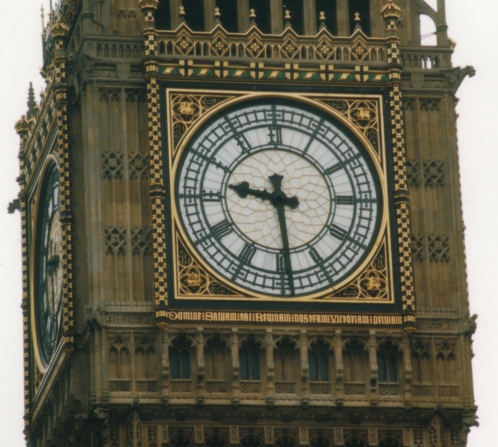
I am thankful for the safe and affordable accommodation in London that friends here have offered me. At both places I've stayed--Islington with Andrew & Cailin and Vauxhall with Inkeri--I've been able to walk to work. And what a walk from Vauxhall! It takes me along and over the Thames and past the Tate Britain, Parliament (see above), Lambeth Palace, the modern apartment where Match Point took place, Westminster Abbey, Big Ben, the Horse Guards, Trafalgar Square, and the Seven Dials.

I am thankful for this 10-month adventure that I'm on, in search of Cheddar, the world, and myself. How lucky I am that I have the time, money, and the courage (and a good dose of recklessness) to give up a comfortable life in the U.S. to travel for travel's sake. Along the way, I am seeing friends and making new ones.

I am thankful for my many friends back in the U.S. who are making the effort to stay in touch with me even though I am no longer in their daily lives. Their support, encouragement, and fond wishes keep me going and will help me adjust when I return.

I am thankful for my family and their unconditional love. I try not to take it for granted that they will always welcome me back and give me love & shelter, even though I've been likened to Dylan Thomas, "that drunken Welsh poet"!

I am thankful that, as far as I know, I am in good health and that I have the NHS in case something goes wrong. I decided not to pay $530 a month for COBRA, partly because it's so expensive, partly because I can have free healthcare in the U.K., and partly because I am so disgusted that the U.S. government found $700 billion to bailout reckless financial institutions but can't "find" this money to provide all Americans with health security. I think this is a human rights violation, especially in a rich, first-world country.

I am thankful that I make the most of my working limbs by going for runs. These days I run in Battersea Park, where there are still some autumn colors and occasionally rays of sun. I am thankful, too, for my running team, Hellgate, back in Queens who made me physically and emotionally stronger. I am thankful to my trainer Jill, at Dolphin Fitness, for the same reasons. Too bad, though, that I am losing my six-pack abs to a steady diet of cheese (breakfast, lunch, and dinner!) and that I can no longer do push-ups. I injured myself doing them one morning in London. Can anyone say, Almost 40 years old?

I am thankful that I am learning to be thankful. I have a good life.

Sunday, November 16, 2008

Good-bye, Cheddar!

In a horrendously expensive city like London, why work at a cheese shop for a measly 7 pounds sterling an hour ? For the cheese, of course! And it’s usually free. Nothing makes me happier at the end of my shift than heading out to the Crown for a pint or two and a cigarette with Martin, the upbeat assistant manager, and having my well-used Neal’s Yard Dairy carrier bag filled to the brim with scraps of cheese that can’t be sold, loaves of good bread, like Poulain, that are left over at the end of t he day, sugary Eccles cakes that had fallen on the floor, and small containers of organic whole milk and double cream that expired that day. For a miser like me, with a taste for fine foods, these free goodies are almost reason enough to work at the Dairy.

But there’s a more noble reason: to play a role, albeit a small one, in promoting and thereby protecting nonindustrialized agricultural foods. If I love Cheddar, I’ve got to do my part to help the flavorful ones stick around. Without places like Neal’s Yard Dairy and people like me working there, the only Cheddar we might know would be the plastic-wrapped, bright orange bricks sold in supermarket chains. It would be good-bye to the good stuff.

The availability of exquisite farmstead Cheddars owes a lot to the Real Cheese movement that started in the 1970s in Britain. It rode on the coattails of the Real Ale and Real Bread movements. Without the efforts of these flavor crusaders--or maybe just larger louts with refined taste!--the foods of rural Britain were destined to be lost, replaced by their unvarying and tasteless counterparts on supermarket shelves.

Neal’s Yard Dairy and their employees in white Wellington boots and the cheesemakers from the British Isles who supply the shop and probably wear regular black Wellies are just a few players in a now greater and slightly more organized food movement. To anyone interested in promoting an alternative and more sustainable food supply, there’s membership in Slow Food International, shares in Community-Supported Agriculture, shopping at farmer’s markets, and reading books about eating locally. These organizations and consumer practices can throw a lifeline to good food from the land, to the producers of this good food, and to the land itself.

These movements are making a difference. Pubs throughout London proudly advertise that they serve real, cask ales. A chef I met last night at the French House in Soho in London, where I drank two glasses of kir in quick session (yes, I know, something French and not English) cooks at a modest pub outside of London and sources meat from only 12 miles away and uses veg that’s in season.

In contrast to these promising changes is the closing of Forfar Dairy in rural Eastern Ontario, not far from Ottawa. I just read about it thanks to Bill and Elise, who are so good about sending me cheese news from Ontario. Forfar Dairy has been around for almost 150 years. Although it has turned a profit since at least 2000, when the current family took it over, it’s had to close because of rising fuel and milk costs and new provincial government regulations. With the passage of the Nutrient Management Act, Forfar would have to build a storage tank for its whey or find an alternative method for disposing it. Currently it spreads whey on nearby fields as fertilizer. Even though this disposal method has caused no problems, the provincial government won’t allow them to continue it, for the sake of protecting groundwater. Now I know, especially in light of the fatal problems the U.S. recently had with spinach, we should be very careful about what agricultural waste might end up in our groundwater, but small places like Forfar, which have no history of negligence, aren’t really the ones who are threatening the food supply. But the passage of this law has guaranteed to put small dairies in jeopardy.

I visited Forfar with Bill and Elise on our way to their lake cottage (see my entry on cheese curds) and found that the quality of their Cheddars shared little resemblance with the ones at Neal’s Yard Dairy; they were only slightly better than the ones in supermarkets. (But their cheese curds were worth arriving early at their retail shop, to get them fresh, milky, and squeaky.) Just the same, I am sorry to see it go. Their closure marks another unfortunate victory for big business and government’s protection of it. Who will now help the remaining small dairies of Ontario, if, in fact, there are any left? As places like Forfar disappear, so too does part of Canada’s dairying history, as well as their sustainable farming practices. If there are no pigs in the area to eat the discarded whey, what makes more sense than spreading it on fields? Sadly, Ontario’s government believes that expensive storage units do.

So, so long Forfar. I hope your loss will inspire a similar real cheese movement in Canada. In the meantime, in my white Wellington boots, I will continue to be a minor crusader for small cheesemakers, and with my sturdy clear plastic bag in hand, I will continue to be a scavenger of their fine cheeses.